robonix.service.vla.action_verify
service
v0.1.0
Lazy in-process VLA action verification service with Drafter verification and target-model fallback.
This RoboNix Service is provided and maintained by Prof. Xiang Chen's group (IFLab), School of Computer Science, Peking University.
RoboNix VLA Action Verify Service
Speculative VLA inference with lazy GPU loading, target-model verification, and deterministic fallback.
简体中文 · What this adds · Demo Video · Release results · Quick Start · Citation





The RoboNix VLA Action Verify Service lets existing Vision-Language-Action (VLA) models verify low-cost action proposals with both the target model and motion priors before execution. Adaptive acceptance, motion compensation, and policy fallback reduce repeated large-model inference while preserving task-level reliability. The research implementation currently supports OpenVLA with Drafter-based proposals, parallel verification, motion-aware compensation, and original-policy fallback. Across the four LIBERO suites, the complete project reaches up to 1.57× end-to-end speedup and 83.7% task success, with 27%–37% acceleration over the speculative baseline.
🎯 What this adds to RoboNix
This repository packages the target OpenVLA and Drafter inference path behind one lifecycle-aware RoboNix capability. The Service owns model loading, speculative verification, target-only recovery, output validation, and cleanup; task orchestration and physical execution remain outside the provider.
| RoboNix gets | Concrete behavior |
|---|---|
| One action-verify capability | verify accepts an instruction and one validated local observation, then returns one candidate action and its inference mode. |
| GPU-safe activation | rbnx boot does not import PyTorch or allocate model memory; both checkpoints load on the first real call. |
| Deterministic recovery | Drafter/speculative failure calls the already-loaded target model; only a target-model failure makes the capability call fail. |
| A self-contained inference implementation | Service inference source ships in the Wheel; model weights remain external deployment assets. |
| A hardware safety boundary | The Service returns a candidate action only. It never sends robot commands or owns the execution loop. |
| Reproducible full-chain evidence | 10 real LIBERO-Goal observations produced 30 Executor/MCP calls with maximum action error 0.0 against direct speculative inference. |
The catalog identity is robonix.service.vla.action_verify; the public
contract is robonix/service/vla/action_verify/verify.
🎬 Demo Video
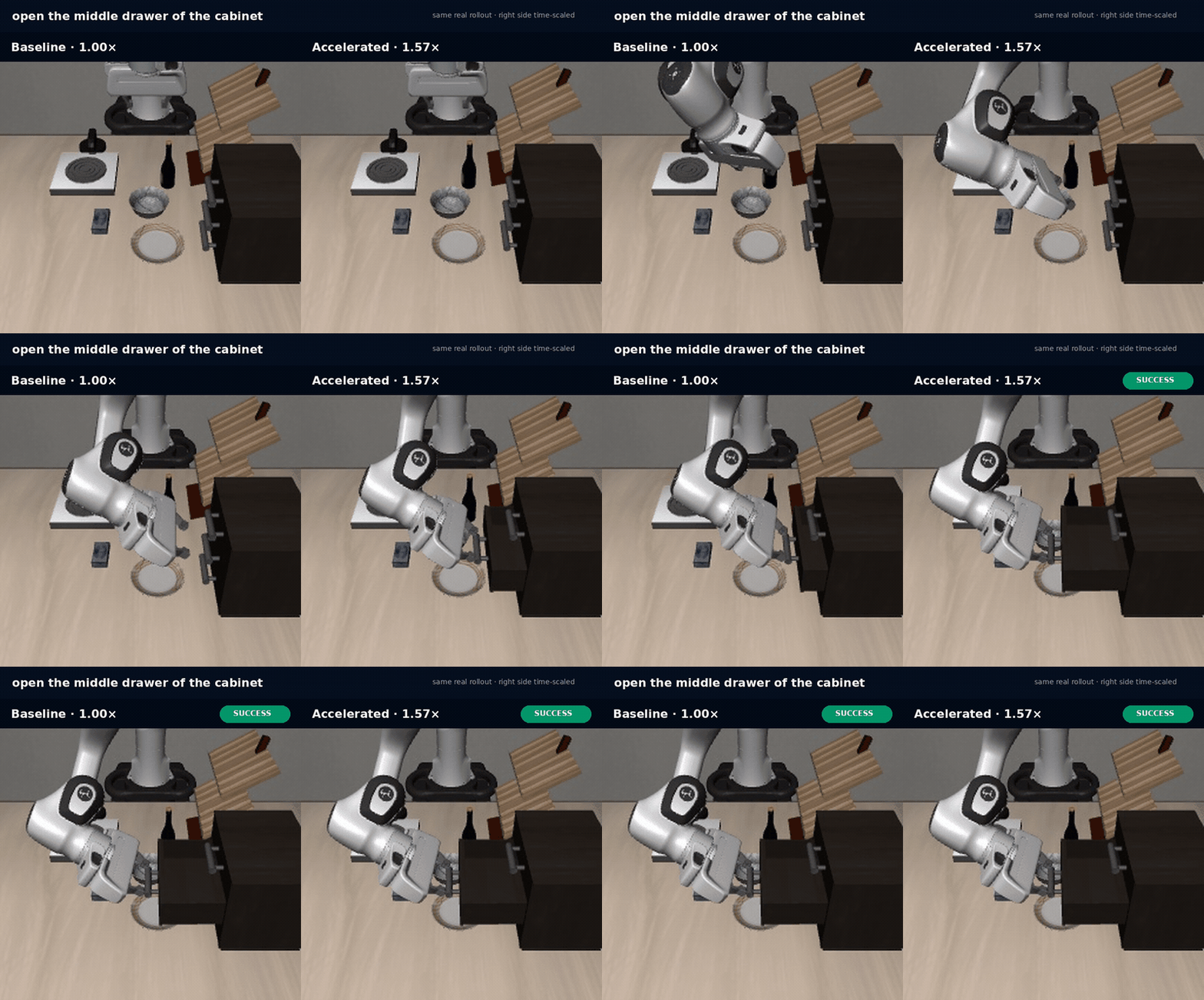
Click the animation to play the MP4. Left: the original motion sequence at 1.00×. Right: the same real successful rollout directly time-scaled to 1.57×.
The video records LIBERO-Goal task 0, initial state 0: “open the middle drawer of the cabinet.” The Service completed the task in 120 policy steps. The full RoboNix route took 42.64 seconds. Both panels use the simulator frames from that one real successful run; the right panel is directly sampled at the project's 1.57× peak ratio and reaches the same terminal frame earlier. This is simulation evidence, not a second timed benchmark or a physical-robot claim. Run, record, and render the same layout with:
python -m pip install 'Pillow>=10' 'imageio>=2.34' 'imageio-ffmpeg>=0.5' 'numpy>=1.26'
python benchmarks/target_server/run_robonix_rollout.py \
  --atlas 127.0.0.1:50351 \
  --provider vla_action_verify \
  --output-dir "$RUN_ROOT" \
  --task-suite libero_goal --task-id 0 --initial-state 0 \
  --max-steps 300 --fps 30

python benchmarks/target_server/render_speed_comparison.py \
  --observations "$RUN_ROOT/observations" \
  --summary "$RUN_ROOT/summary.json" \
  --output "$RUN_ROOT/vla-speed-comparison.mp4" \
  --speedup 1.57 --fps 30
⚡ RoboNix release results
Release candidate 0.1.0 was exercised through the real path
Executor → Atlas → MCP → Service → packaged inference → external checkpoints,
rather than by importing the provider class directly.
| Release evidence | Measured value | Structured source |
|---|---|---|
| Real inputs | 10 LIBERO-Goal observations | benchmarks/target_server/input_manifest.json |
| Full-chain parity | 30 calls, maximum action error 0.0 | benchmarks/target_server/results/summary.json |
| Executor/MCP latency | P50 182.88 ms, P95 212.10 ms | benchmarks/target_server/results/calls.csv |
| Service wrapping cost | P50 9.88 ms | benchmarks/target_server/results/summary.json |
| Target-model fallback | Verified by real post-load Drafter fault injection | benchmarks/target_server/results/fallback.json |
| Lazy model construction | 12.64 s; first full call 13.98 s | benchmarks/target_server/results/model_load.json |
| Measured P50 speedup | 1.034×, not a material speedup | benchmarks/target_server/results/summary.json |
| Peak process GPU allocation | 39,603 MiB, an explicit 40 GB deployment risk | benchmarks/target_server/results/summary.json |
| Recorded live rollout | Success in 120 policy steps | benchmarks/target_server/results/rollout-summary.json |
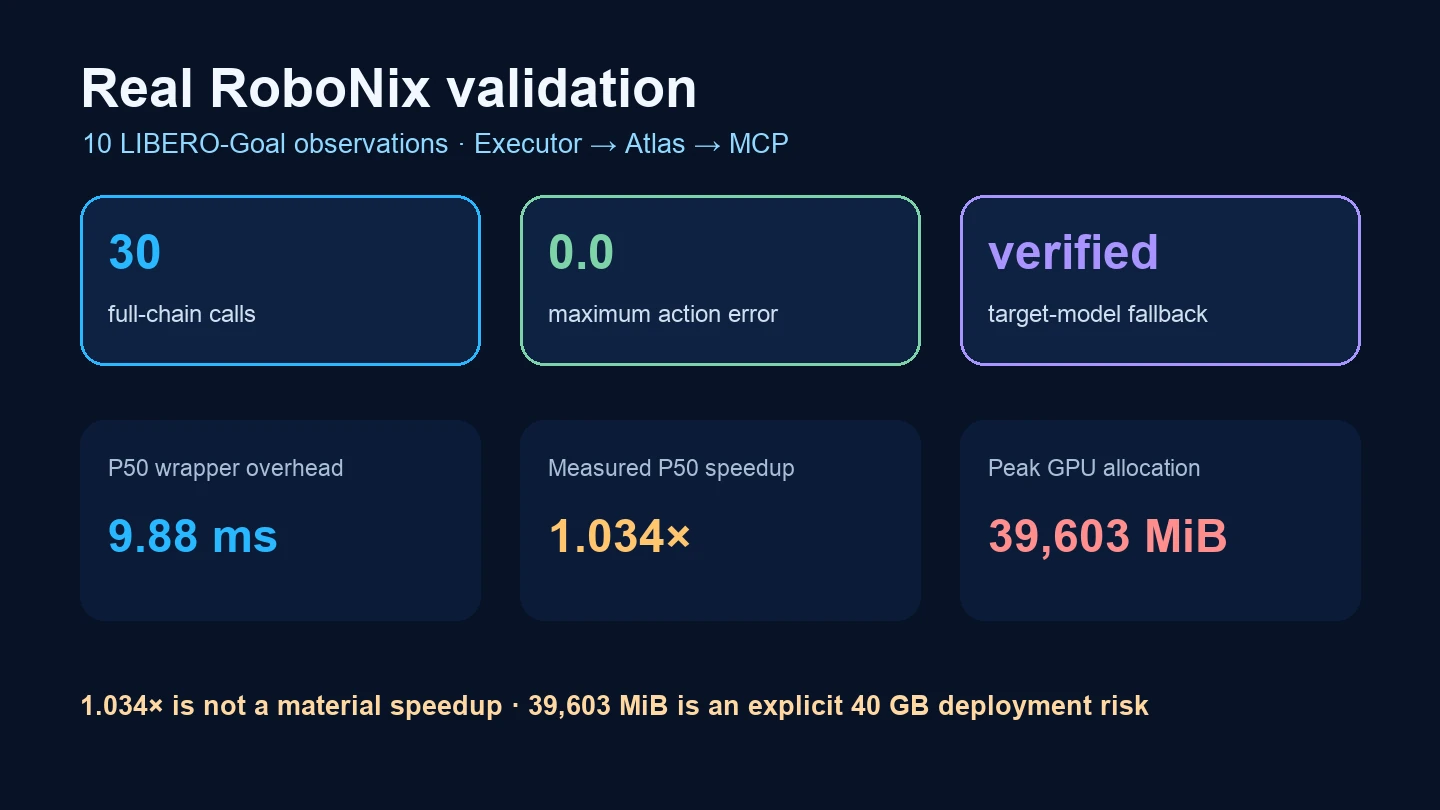
Figure 1. Real release validation. Correctness and fallback are verified; this deployment does not establish a material speculative speedup.
Start by goal
| Goal | Entry point | Required resources |
|---|---|---|
| Verify the package contract | python -m pytest -q && python scripts/release_audit.py |
CPU only |
| Run a mock RoboNix deployment | examples/minimal-deployment/README.md |
CPU only; no checkpoints |
| Run the real Service | examples/real-deployment/README.md |
RoboNix, CUDA, target checkpoint, and Drafter checkpoint |
| Invoke through Executor/MCP | benchmarks/target_server/invoke_executor.py |
A booted deployment and a valid local observation |
| Reproduce parity and fallback | benchmarks/target_server/run_benchmark.py |
An isolated inference environment and free 40 GB-class GPU |
| Record and compare a real rollout | run_robonix_rollout.py + render_speed_comparison.py |
Booted Service, LIBERO, checkpoints, and a free 40 GB-class GPU |
RoboNix Service package
The repository root is directly publishable as
robonix.service.vla.action_verify. It exposes
robonix/service/vla/action_verify/verify, returns candidate actions only,
and never commands robot hardware. RoboNix activation does not import PyTorch
or allocate GPU memory; the target model and Drafter load on the first real
request.
For repository checks:
python -m pip install -e '.[dev]'
python -m pytest -q
python scripts/release_audit.py
python -m build
python scripts/verify_distribution.py
rbnx validate .
rbnx build -p .
For real inference, use Python 3.10 or 3.11 in a CUDA-compatible environment
and install .[inference]. The Wheel contains the Service adapter and the
OpenVLA/SpecVLA inference source; checkpoints remain deployment inputs and are
not stored in Git. Point ROBONIX_SERVICE_PYTHON at that environment when
RoboNix starts the Service. See CAPABILITY.md for the public
interface, examples/minimal-deployment/README.md
for complete mock and real configurations, and VALIDATION.md
for the exact validation boundary. The complete research implementation and
benchmark material below remain in this repository.
Real RoboNix deployment
The release path is:
Executor -> Atlas -> MCP -> vla_action_verify
         -> repository-packaged OpenVLA/SpecVLA source -> external checkpoints
It returns one candidate action and never commands robot hardware. Existing checkpoints and observations should be connected from a large-volume data root through checked symbolic links; do not copy weights into this repository. The validation host's concrete storage layout and safe-link procedure are in benchmarks/target_server/README.md.
python3.10 -m venv /path/to/environments/vla-service
source /path/to/environments/vla-service/bin/activate
python -m pip install --upgrade pip
python -m pip install -e '.[dev,inference]'

rbnx validate .
rbnx build -p .

cd examples/real-deployment
cp .env.example .env
# Edit the untracked .env with checkpoint, input-root, GPU, cache, runtime,
# and Service-Python paths for this deployment.
set -a
source .env
set +a

rbnx build -f robonix_manifest.yaml
rbnx boot -v --no-update-check -f robonix_manifest.yaml
rbnx caps -v --server 127.0.0.1:50351
rbnx tools --server 127.0.0.1:50351
rbnx describe --server 127.0.0.1:50351 --provider vla_action_verify
rbnx inspect --server 127.0.0.1:50351
Before the first call, the Service process must not have mapped PyTorch and must not occupy the selected GPU. Invoke through Executor:
python ../../benchmarks/target_server/invoke_executor.py \
  --atlas 127.0.0.1:50351 \
  --provider vla_action_verify \
  --contract robonix/service/vla/action_verify/verify \
  --args-json '{"instruction":"pick up the bowl","observation_uri":"/absolute/input/observation.jpg","timeout_s":600}' \
  --timeout-s 900

rbnx shutdown -f robonix_manifest.yaml
The first verify lazily imports the inference stack and loads both models.
If speculative decoding fails, the already-loaded target model is called; only
dual failure fails the MCP call. The local observation must remain below
allowed_image_root and pass signature, size, and pixel-count checks.
Configuration fields and defaults are defined in config.spec.
📊 Performance snapshot
The project evaluates motion-aware verification and recovery across all four LIBERO suites. Results report task success rate (SR) and end-to-end speedup over the naive speculative VLA path.
| LIBERO suite | SR | Speedup |
|---|---|---|
| Goal | 75.6% | 1.54× |
| Object | 72.3% | 1.49× |
| Spatial | 83.7% | 1.57× |
| Long | 48.8% | 1.48× |
📚 Table of Contents
- What this adds to RoboNix
- Demo Video
- RoboNix release results
- Real RoboNix deployment
- 📊 Performance snapshot
- 📰 News
- ⚡ System Capability and Results
- 🧠 Architecture Overview
- 🔌 RoboNix Integration and Outlook
- 🧪 Validated Release
- ⚙️ Requirements
- 🚀 Quick Start
- 🧰 Installation and Configuration
- 🏋️ Drafter Training
- 🎬 LIBERO Rollout
- 🩺 Troubleshooting
- 🗺️ Roadmap
- 📝 Citation
- 🤝 Contributors
- 📄 License
📰 News
- 2026-07-19: 🆕 Released the system-level VLA action verification Service with capability results, model support, and bilingual documentation.
- 2026-07-18: 🔥 Validated independent-root execution, target and Drafter checkpoint loading, and a bounded 100-step LIBERO rollout with H.264 video export.
- 2026-07-18: 🛠️ Added configurable DeepSpeed paths, task selection, rollout step caps, and an import-compatible OpenVLA namespace.
⚡ System Capability and Results
From the RoboNix runtime perspective, this Service sits between candidate action generation and robot execution. It verifies proposed actions, compensates recoverable motion errors, and triggers deterministic policy fallback when a candidate cannot be trusted.
| System-level result | Current capability |
|---|---|
| End-to-end acceleration | More than 1.45× across evaluated LIBERO suites |
| Gain over fixed-threshold speculative execution | More than 25% additional acceleration |
| Execution reliability | Near-baseline task success with motion-aware compensation and fallback |
| Open-source rollout | OpenVLA + trained Drafter, 100 bounded steps, H.264 video exported |
Supported models
| Model family | Status | Scope |
|---|---|---|
| OpenVLA | ✅ Completed | Drafter training, candidate generation, verification, compensation, fallback, and LIBERO rollout |
| Other token-based VLA models | ⏳ In progress | Pluggable model and Drafter interfaces are planned |
🧠 Architecture Overview
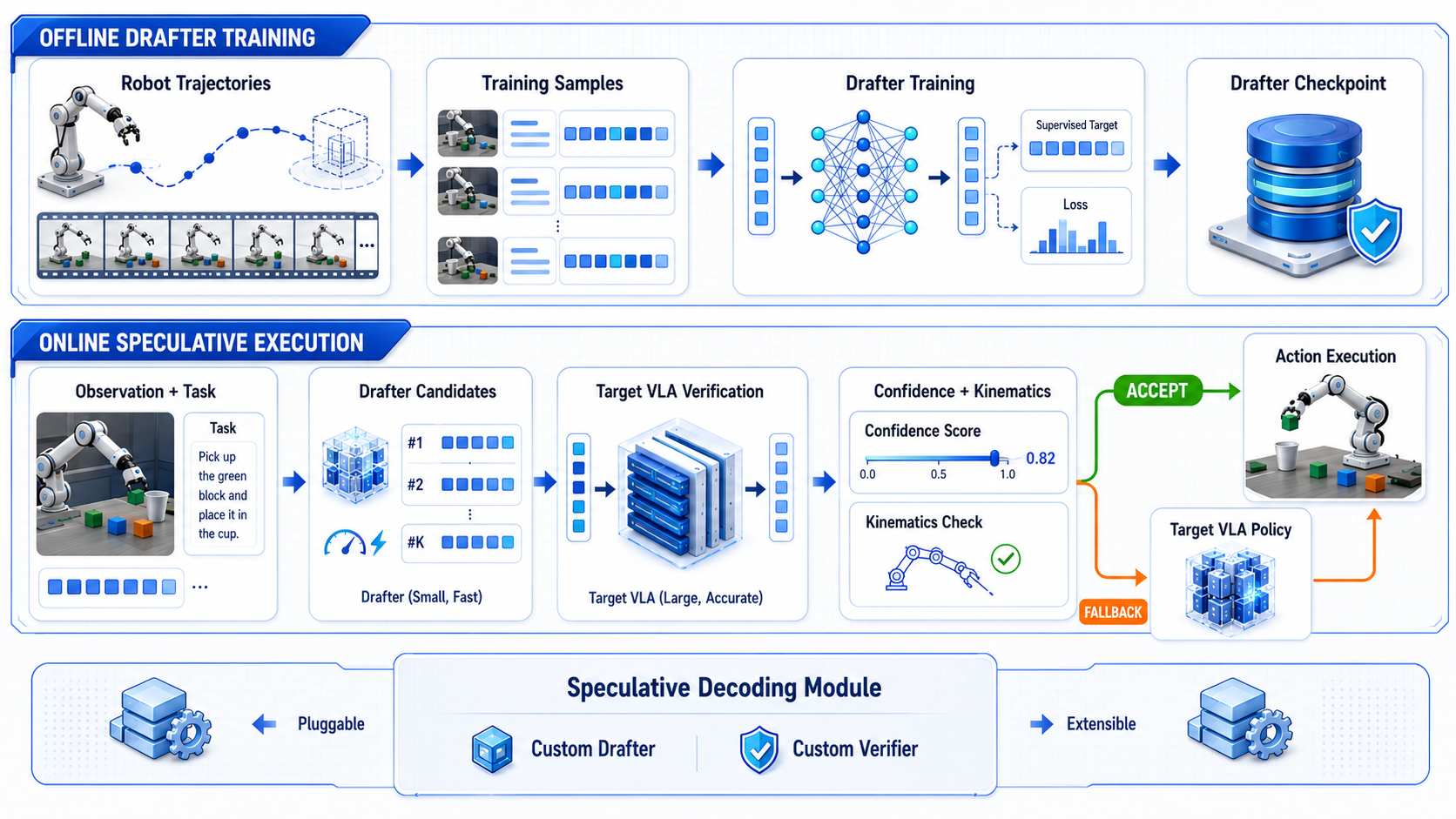
Figure 2. Offline Drafter preparation and online speculative execution with confidence, kinematic acceptance, and target-policy fallback.
Unlike fully autoregressive decoding, speculative decoding uses a smaller draft model to propose multiple candidates before invoking the target model. The target model validates these candidates in parallel. Actual speedup depends on the acceptance rate, candidate-tree shape, GPU, model configuration, and task, and must be measured against an autoregressive baseline under identical conditions.
🔌 RoboNix Integration and Outlook
This Service is an independently deployable RoboNix provider connected through stable capability contracts. Physics-prior verification and fallback remain inside the provider, while Atlas handles discovery, Nexus transports requests, and Executor dispatches the resulting capability without changing the RoboNix core.
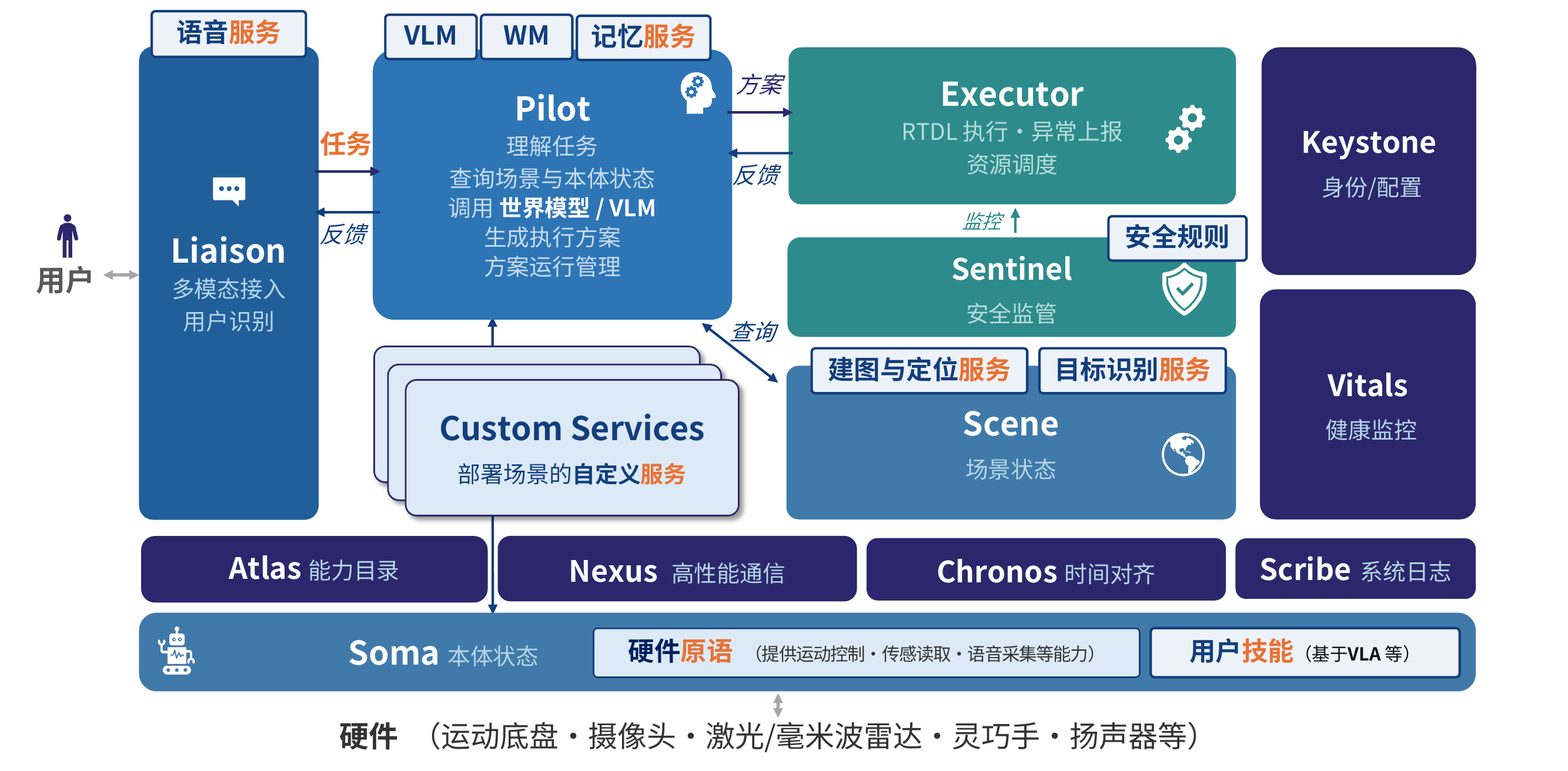
Figure 3. System-level integration points for reusable memory services, custom services, and VLA-based user skills.
Looking forward, the same interface can support additional Drafters, physical constraints, verification policies, and online data feedback. The long-term goal is a reusable embodied-execution service whose algorithms can evolve independently from robot hardware and the RoboNix runtime.
🧪 Validated Release
Release candidate 0.1.0 was validated on 2026-08-01 with RoboNix commit
48af09190b99f7847dddf68457eec2db42d2c1a7, an A100 40GB GPU, the external
OpenVLA LIBERO-Goal checkpoint and compatible Drafter, and ten real
LIBERO-Goal observations.
| Route | Calls | Mean | P50 | P95 |
|---|---|---|---|---|
| Direct target-only | 30 | 179.31 ms | 178.95 ms | 181.03 ms |
| Direct speculative | 30 | 176.12 ms | 173.00 ms | 202.72 ms |
| Executor -> Atlas -> MCP | 30 | 187.45 ms | 182.88 ms | 212.10 ms |
The 30 direct speculative and 30 full RoboNix actions matched exactly:
maximum error 0.0. A real Drafter fault injection reached target-model
fallback, and shutdown returned GPU 1 from model occupancy to its 3 MiB idle
baseline. Model construction took 12.64 s; the first full Service call took
13.98 s; P50 wrapping overhead was 9.88 ms.
The measured target-to-speculative P50 speedup was only 1.034x, so this release does not claim a material speedup. Process-level GPU allocation peaked at 39,603 MiB because the preserved TensorFlow preprocessing stack reserved most remaining memory; this is an explicit deployment risk on a 40GB GPU.
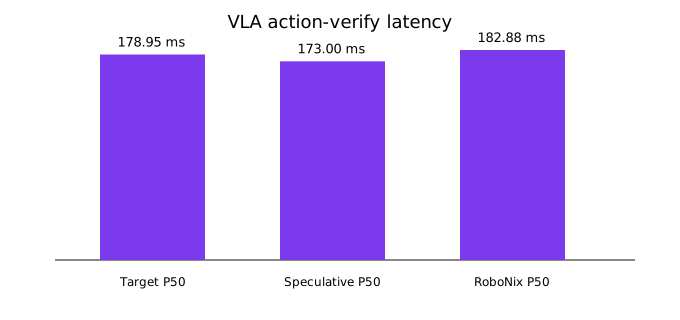
Raw calls, fallback evidence, exact environment, and reporting limits are in benchmarks/target_server/ and VALIDATION.md.
Separately, the preserved research workflow previously completed a bounded 100-step LIBERO smoke rollout. It proves simulator integration and video export, not task success:
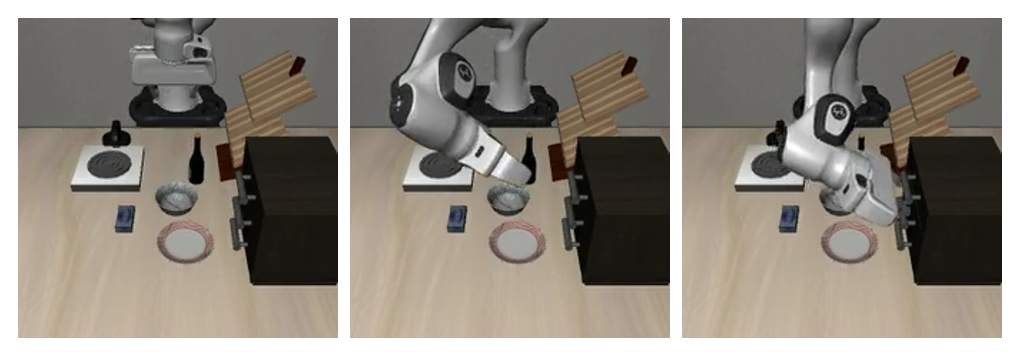
Validated smoke rollout: first, middle, and final frames from the 100-step run.
🚀 Quick Start
The repository never ships model weights or datasets. Point the commands below to existing assets on a large data volume.
conda create -n robonix-spec python=3.10 -y
conda activate robonix-spec
python -m pip install --upgrade pip
python -m pip install -r requirements.txt
python -m pip install -e . --no-deps

python -m pytest -q tests
python -m scripts.run --help
Run one bounded rollout with a compatible target checkpoint and Drafter:
export PYTHONPATH="$PWD/vendor/openvla:/path/to/LIBERO:${PYTHONPATH:-}"
export CUDA_VISIBLE_DEVICES=0
export MUJOCO_GL=egl
export MUJOCO_EGL_DEVICE_ID=0

python -m scripts.run \
  experiments/robot/libero/run_libero_goal_Spec.py \
  --model_family openvla \
  --pretrained_checkpoint /data/checkpoints/openvla_goal \
  --spec_checkpoint /data/checkpoints/drafter_goal \
  --task_suite_name libero_goal \
  --task_ids 0 \
  --num_trials_per_task 1 \
  --max_steps_override 100 \
  --local_log_dir /data/outputs/speculative \
  --center_crop True \
  --use_wandb False
Videos are written below ./rollouts/<date>/; evaluation logs use the supplied
--local_log_dir. A 100-step cap is for deployment verification, not success
rate measurement.
⚙️ Requirements
| Component | Requirement |
|---|---|
| Operating system | Linux recommended, especially for DeepSpeed and headless LIBERO/MuJoCo |
| Python | 3.10+ for package checks; 3.10 or 3.11 for the pinned inference dependencies |
| PyTorch | 2.2.0 |
| CUDA | The upstream setup was tested with CUDA 12.1; match PyTorch, CUDA, and driver versions |
| Simulation | LIBERO 0.1.0 and MuJoCo/EGL for evaluation |
| Training | DeepSpeed 0.16.6; multi-GPU hardware recommended |
The repository does not include model weights, datasets, or LIBERO assets. Prepare the following before running the full pipeline:
- a target OpenVLA/VLA checkpoint;
- a compatible draft-model checkpoint for speculative evaluation;
- the LIBERO dataset and simulator environment;
- writable directories for generated data, checkpoints, and evaluation logs.
🧰 Step 1: Installation
Clone the project and run all commands from the repository root:
git clone https://github.com/lusunn111/service-vla-action-verify-rbnx.git
cd service-vla-action-verify-rbnx

conda create -n spec-decoding python=3.10 -y
conda activate spec-decoding

python -m pip install --upgrade pip
python -m pip install -r requirements.txt
python -m pip install -e . --no-deps
The root requirements.txt is the reproducible installation entry and delegates
to requirements/requirements-min.txt. Additional LIBERO dependencies are in
benchmarks/libero/experiments/libero_requirements.txt. Install CUDA-dependent
packages using builds compatible with the local driver and toolkit.
Run lightweight smoke checks after installation:
python -c "import service_bootstrap as s; print(s.activate_vendor())"
python -m scripts.run --help
🔧 Step 2: Configuration
Copy the environment template and replace every placeholder with a local path:
cp configs/.env.example configs/.env
SPEC_MODEL_ROOT=/path/to/models
SPEC_DATA_ROOT=/path/to/datasets
SPEC_OUTPUT_ROOT=/path/to/outputs
LIBERO_ROOT=/path/to/libero
CUDA_VISIBLE_DEVICES=0
The template documents the path convention but is not loaded automatically by the current research scripts. Export the variables in the shell or pass the corresponding paths through each script's configuration.
Some preserved upstream scripts still contain machine-specific or PATH_TO_* placeholders. Locate and replace them before running a full experiment:
grep -R "PATH_TO\|/SpecVLA" scripts vendor/openvla/specdecoding \
  vendor/openvla/experiments/robot/libero
🧱 Step 3: Generate Draft-Model Training Data
The stable runner accepts a script path relative to vendor/openvla/ and forwards all remaining arguments unchanged:
python -m scripts.run \
  specdecoding/train-scripts/ge_data_all_openvla_token_only_libero_goal.py \
  --start 0 \
  --end 100 \
  --index 0 \
  --gpu_index 0 \
  --outdir /path/to/generated-data
| Argument | Description |
|---|---|
--start, --end |
Range of samples to process |
--index |
Worker or generation job index |
--gpu_index |
One or more GPU indices |
--outdir |
Output directory for generated training samples |
The script's vla_path, dataset path, and related values are currently source-level configuration fields. Set them to valid local assets before execution.
🏋️ Step 4: Train the Draft Model
- Review
configs/ds_config.jsonandconfigs/llama_2_chat_7B_config.json. - Configure the target VLA, generated dataset, and output paths in
FinetuneConfig. - Launch training with DeepSpeed.
Example:
cd vendor/openvla/specdecoding/train-scripts

OPENVLA_CHECKPOINT=/path/to/openvla \
DRAFTER_TRAIN_DATA=/path/to/generated-data \
DRAFTER_OUTPUT_DIR=/path/to/drafter-checkpoints \
GPU_IDS=0,1 \
WANDB_MODE=offline \
bash train_ds_libero_goal.sh
Adjust GPU indices and the distributed port for the local environment. For reproducibility, record the Git revision, target-model version, data version, DeepSpeed configuration, GPU model, and random seed for every training run.
🎬 Step 5: Evaluate on LIBERO
Configure headless rendering before running an evaluation:
export CUDA_VISIBLE_DEVICES=0
export MUJOCO_GL=egl
export MUJOCO_EGL_DEVICE_ID=0
Autoregressive Baseline
python -m scripts.run \
  experiments/robot/libero/run_libero_goal_AR.py \
  --model_family openvla \
  --pretrained_checkpoint /path/to/openvla-checkpoint \
  --task_suite_name libero_goal \
  --center_crop True \
  --use_wandb False
Standard Speculative Decoding
python -m scripts.run \
  experiments/robot/libero/run_libero_goal_Spec.py \
  --model_family openvla \
  --pretrained_checkpoint /path/to/openvla-checkpoint \
  --spec_checkpoint /path/to/drafter-checkpoint \
  --task_suite_name libero_goal \
  --task_ids 0 \
  --num_trials_per_task 1 \
  --center_crop True \
  --use_wandb False
Relaxed Acceptance
The repository retains experimental entry points for thresholds 9, 15, and 20. For example:
python -m scripts.run \
  experiments/robot/libero/run_libero_goal_Spec_Relaxed_15.py \
  --model_family openvla \
  --pretrained_checkpoint /path/to/openvla-checkpoint \
  --task_suite_name libero_goal \
  --center_crop True \
  --use_wandb False
Supported task suites include libero_spatial, libero_object, libero_goal, libero_10, and libero_90. Use --center_crop True when the target model was fine-tuned with the corresponding image augmentation. Supply a compatible Drafter with --spec_checkpoint; use --task_ids and --max_steps_override for bounded validation before running a complete suite.
📊 Benchmarking Guidelines
Run autoregressive and speculative entry points with the same hardware, target model, task suite, and random seeds. At minimum, report:
- task success rate and successful episode count;
- end-to-end episode latency;
- per-action generation latency and throughput;
- candidate acceptance rate and average accepted length;
- fallback count;
- peak GPU memory and utilization;
- candidate-tree width, depth, and acceptance configuration.
Do not report model-forward latency as end-to-end latency. Image preprocessing, simulator stepping, warm-up, synchronization, and logging can materially affect results. Warm up the model, repeat runs, and report both averages and percentiles.
🗂️ Repository Layout
.
├── modules/                  # Lazy, task-oriented module catalogs
│   ├── drafter/              # Draft networks and proposal logic
│   ├── candidate_generation/ # Candidate-tree generation
│   ├── verification/         # Parallel target-model verification
│   ├── acceptance/           # Acceptance, KV cache, and fallback
│   ├── strategies/           # Standard and experimental strategies
│   ├── data/                 # Data-related entry points
│   └── training/             # Training-related entry points
├── scripts/                  # Stable runner and workflow entry points
├── benchmarks/libero/        # LIBERO experiments and speed tests
├── configs/                  # DeepSpeed, model, and environment templates
├── requirements.txt          # Reproducible installation entry
├── requirements/             # Core dependency pins
├── tests/                    # Layout, registry, and lazy-import tests
├── docs/assets/              # Architecture assets and the web ImageGen prompt
├── utils/                    # Common, loading, and KV-cache utilities
├── vendor/openvla/           # Canonical, import-compatible source tree
└── service_bootstrap.py      # Vendor activation and guarded script runner
vendor/openvla/ is the canonical compatibility copy. The top-level modules/, scripts/, and benchmarks/ directories provide an engineering-oriented view of the implementation. When changing an algorithm, clearly identify the authoritative layer and keep any convenience copies synchronized.
The default strategy is modules.strategies.modeling_speculation. The _1, _14, _7d, _jiou, and _yuzhi variants represent distinct research experiments and intentionally remain separate.
🩺 Troubleshooting
rbnx boot shows no GPU allocation
That is the intended lifecycle. Activation registers the capability without
importing PyTorch; target and Drafter checkpoints load on the first verify.
Use rbnx caps, rbnx tools, and rbnx describe to verify registration before
issuing the first model request.
The first request is much slower than later requests
The first request includes inference-stack import, checkpoint construction, and GPU allocation. Measure cold start separately from steady-state latency. Do not average the first call into warm P50/P95 results without saying so.
The process exhausts a 40 GB GPU
Check both model allocation and framework-level reservation. The validated environment observed TensorFlow preprocessing reserve most remaining memory, raising process allocation to 39,603 MiB. Use an isolated GPU, avoid colocating another model, and inspect process ownership before terminating anything.
Drafter inference fails
The Service should reuse the loaded target model and return
mode=target_fallback with fallback_used=true. If the entire MCP call fails,
inspect whether the target path also failed. Fault injection belongs in the
benchmark harness; production requests do not expose a test switch.
The observation is rejected before model loading
Resolve the path and verify that it stays below allowed_image_root. The image
must pass signature, byte-size, and pixel-count checks. Network URLs are not
accepted in version 0.1.0, so download and validate an observation outside the
Service before placing it in the configured input directory.
Direct inference and MCP actions differ
Lock the same checkpoint, Drafter state, preprocessing configuration, instruction, image bytes, and random state. Compare the seven action values before simulator execution. If the speculative path failed previously, clear its candidate-tree state before evaluating target-only fallback.
Cleanup after validation
Use rbnx shutdown -f robonix_manifest.yaml, confirm the provider process has
exited, and then check the selected GPU. Only terminate processes started by
this deployment; a shared GPU or runtime may host unrelated experiments.
🗺️ Roadmap
- [x] Publish an independently runnable source-only repository.
- [x] Validate target-model and Drafter loading plus bounded video rollout.
- [x] Package motion-aware verification, compensation, and policy fallback as one execution path.
- [x] Adopt the RoboNix Mulan PSL v2 license and remove citation placeholders.
- [ ] Publish compatible Drafter checkpoints with checksums and model cards.
- [ ] Add autoregressive-versus-speculative benchmark tables and acceptance metrics.
- [ ] Add more Drafter architectures and verification strategies.
- [ ] Validate additional VLA model families through the same Service contract.
- [x] Provide the versioned RoboNix Service adapter and capability contract.
📝 Citation
If this Service supports your research, please consider giving the repository a star ⭐ and citing this software repository:
@software{mao2026robonix_vla_action_verify_service,
  author  = {Mao, Zhihao and He, Huiru and Zheng, Zihao},
  title   = {RoboNix VLA Action Verify Service},
  year    = {2026},
  version = {0.1.0},
  url     = {https://github.com/lusunn111/service-vla-action-verify-rbnx}
}
🤝 Contributors
We thank HuiruHe and zhengzihaoPKU for their contributions to the Service. Zihao Zheng co-authored the related research and contributed code improvements. See CONTRIBUTORS.md for the contributor policy.
📄 License
The project is licensed under the Mulan Permissive Software License, Version 2 (Mulan PSL v2); see LICENSE. Vendored components retain their included licenses.