robonix.robot.jaka.mini_with_linker_hand_o6
robot
v0.1.0
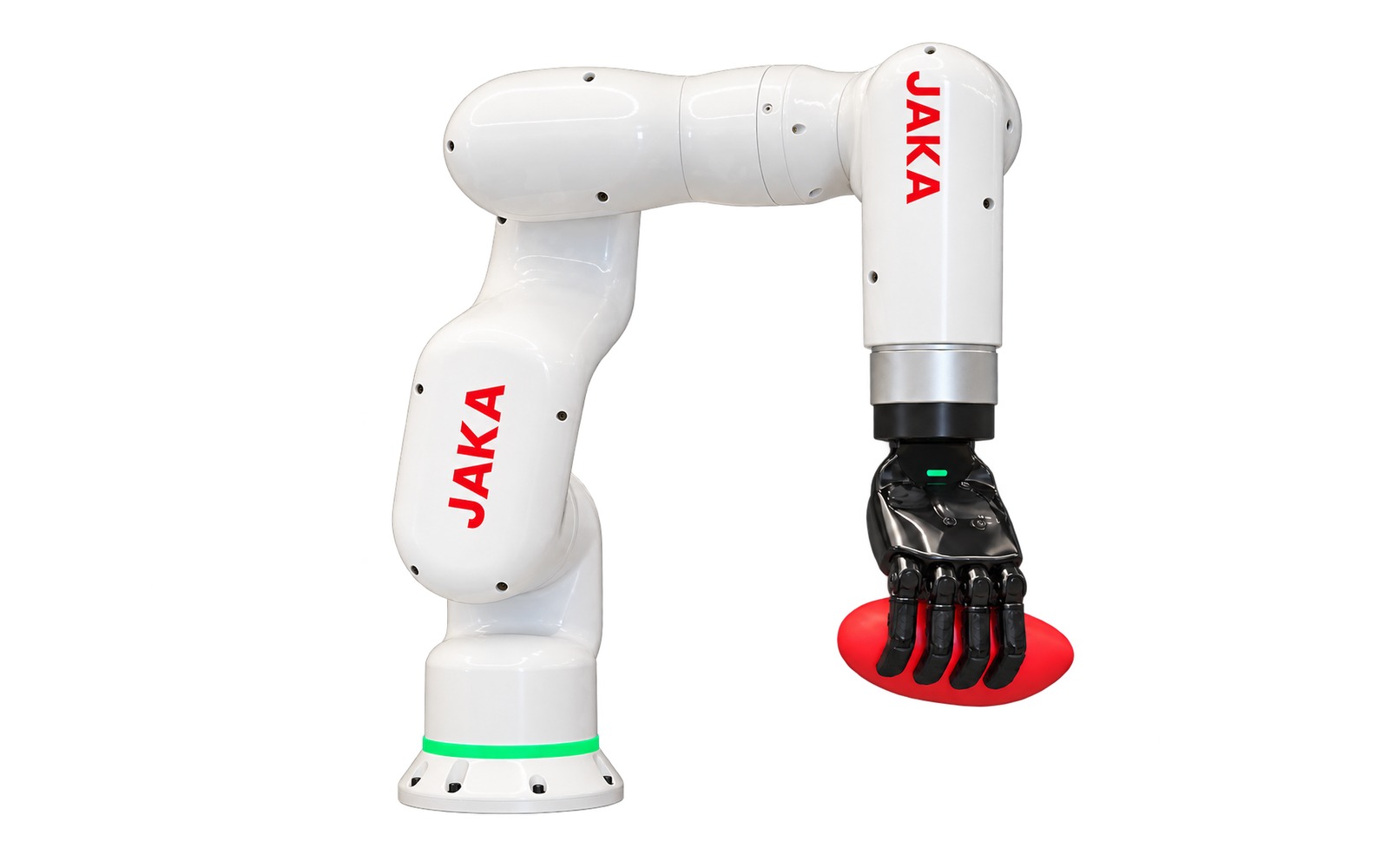
Robonix deployment for the JAKA Mini arm with a LinkerHand O6 dexterous hand.
robot-jaka-mini_with_linker_hand_o6 — JAKA Mini + LinkerHand O6 deployment
Robonix deployment for the fixed-base JAKA Mini 6-DOF arm with a
LinkerHand O6 six-axis dexterous hand (controller end RS485L). The arm and
the hand are driven by one combined primitive,
primitive-jaka-mini_with_linker_hand_o6-arm_hand-rbnx,
over TCP to the controller (jkrc SDK): it serves robonix/primitive/arm/*
always and robonix/primitive/hand/* in end_effector: hand mode.
The TG-9801 gripper variant of this deployment lives in the original robot-jaka-mini_with_tg9801_gripper repository.
Hardware & platform
| item | value |
|---|---|
| arm | JAKA Mini, controller at 10.5.5.100 (config jaka_arm.ip) |
| end effector | LinkerHand O6 six-axis dexterous hand, RS485 Modbus RTU via the controller end channel (slave 0x27 right) |
| camera | Orbbec Gemini 336L (USB 2bc5:0807), overhead/fixed — RGBD, 1280×720 |
| platform | Jetson Orin, JetPack 6 (aarch64), ROS 2 Humble + rmw_zenoh_cpp |
| base | fixed (no mobile base, no navigation) |
Packages
The committed manifest references packages by url: — catalog-resolvable for
the package site; rbnx boot fetches them into rbnx-boot/cache/:
| package | repo | role |
|---|---|---|
jaka_arm |
syswonder/primitive-jaka-mini_with_linker_hand_o6-arm_hand-rbnx | arm + O6 hand primitive — robonix/primitive/arm/* always, robonix/primitive/hand/* with end_effector: hand, one jkrc session |
orbbec_camera |
syswonder/primitive-orbbec-camera-rbnx | Orbbec camera primitive — robonix/primitive/camera/{rgb,depth,camera_info} (Gemini 336L via gemini_330_series.launch.py) |
jaka |
syswonder/skill-jaka-grasp-rbnx | the same six capabilities as before (grab/release/home/place/pick + jaka_fixed_grasp) — unchanged by the hand swap |
On the deploy machine, a gitignored robonix_manifest.local.yaml (same
content, path: instead of url: for the three packages above) makes
build.sh / start.sh build and boot the sibling checkouts
(../primitive-jaka-mini_with_linker_hand_o6-arm_hand-rbnx,
../primitive-orbbec-camera-rbnx, ../skill-jaka-grasp-rbnx) directly — no
GitHub fetch, unpushed local edits take effect. robot_description has no
local checkout and stays url: (built from rbnx-boot/cache/; refresh with
rbnx update).
One primitive, one jkrc session
The O6 hangs on the controller's end RS485L channel, the same wire and the same jkrc connection the arm uses. Two hard constraints make the arm and hand one primitive rather than two packages:
- the controller permits one active SDK session — a second process that
logs in makes the first process's
get_actual_joint_positionhang indefinitely (measured 2026-10-22 on the real controller); - the controller's RS485 signal table is global across SDK sessions and misaligns with more than one entry.
So jaka_arm owns the single session and the single signal table, and in hand
mode serves both contract families from the same provider id. A standalone hand
primitive was prototyped and backed out for exactly this reason; do not add a
second jkrc client, a TG-9801 tool, or a hand driver on the same controller
while this stack runs.
Hand interface
In end_effector: hand mode the same provider serves:
| capability | transport | what |
|---|---|---|
hand/info |
gRPC | six control axes with finger/type/description |
hand/move_joint |
gRPC | position by axis name, normalized [0,1] (1 = flexed) |
hand/set_joint_speed_limits |
gRPC | per-axis speed ceilings |
hand/set_joint_torque_limits |
gRPC | per-axis torque ceilings |
hand/state_joint |
ROS 2 | /jaka/hand/state_joint, normalized positions |
The six axes are thumb_cmc_pitch, thumb_cmc_yaw, index_mcp_pitch,
middle_mcp_pitch, ring_mcp_pitch, pinky_mcp_pitch — the same names the
URDF uses, so the hand joints match by name. The distal joints are mechanically
coupled and are not separate axes. Positions are normalized (0 = extended, 1 =
fully flexed; thumb opposition 0 = neutral, 1 = full); limits are 0 = minimum,
1 = maximum. move_joint rejects empty/unknown/duplicate/out-of-range requests
and never clamps; ok=true means accepted and dispatched, not reached. At
activation the hand pose is unknown — a lost RS485 answer reads as fully
flexed, so a read is not a safe target seed — and the first move_joint must
list all six axes; later requests may be partial and hold the unlisted axes.
The skill's gripper_joint open/grip is a full six-axis pose and seeds the
same cache, so it needs no special first call.
joint_states carries the six arm joints and the six hand joints (rad, 0 =
extended) in one message, so robot_state_publisher drives the whole body in
RViz. The read path is one single-entry RS485 poll per register (~0.38 s; a
six-axis sweep ~2.3 s), so the hand state runs at roughly one sweep per
hand_publish_period_s cycle — slow but continuous, not 50 Hz. The O6 answers
slowly (2~5 s) after a motion and a lost answer reads as 0, so read a verdict
after the motion settles.
Unchanged skill, gripper_joint mapping
The skill still grips the way it did with the TG-9801: it publishes
sensor_msgs/JointState{name: ["gripper_joint"], position: [m]} on
/jaka/joint_command. In hand mode jaka_arm maps >= 0.049 m → O6 open
pose, < 0.049 m → full five-finger grasp; the skill's five-publish burst is
idempotent (the same pose is re-issued and settles). The skill config declares
the body with the required end_effector: hand (gripper for the TG-9801
deployment); a missing value is reported as a skill config error. What changes
for the skill is only configuration: the O6 palm is longer, so the
desktop/grasp heights are 0.14 m, and gripper_settle_s is raised to 3 s so
the fingers finish closing before the lift. For the grasp verdict the skill reconstructs a width-like
opening from the hand joints in joint_states (thumb/index/middle/ring
flexion, the same 0.098 m scale and thresholds as the gripper), so the
empty-grasp/open checks keep working without gripper_joint. The O6's
lost-answer clusters can still look like a fully-closed hand — the verdict
waits for two settled samples, but treat a critical grasp with care. The hand
joints are also on /jaka/hand/state_joint.
Pick skill (camera-driven grasp)
jaka_pick locates a named object and grasps it: resolve camera/rgb → grab a
frame → detect → a calibrated 2D hand-eye homography maps the bbox centre
to arm base_link XY → grasp at (x, y, desktop_height) with a vertical-down
orientation. It reuses the same grasp segment as grab.
Two detection backends (detect_scheme in the skill config):
yolo(deploy default): in-process yolo11-obb — the fruit model (carrot/potato/tomato) reused from the agilex deploy atrobot-agilex-robonix/host-services/yolo/weights/best.pt(point theYOLO_MODEL_PATHenv var at it — the manifest forwards it toyolo_model_path; the skill interpreter has CUDA torch + ultralytics). Two-frame consistency filters flicker; Chinese phrasing maps to class names viayolo_class_aliases(胡萝卜→carrot …); the OBB rotation aligns the gripper yaw to the object's long edge (rz = grasp_yaw_offset_deg - yaw, default -90 = this arm's tuned value).vlm: open-vocabulary multimodal detection (pixel bbox, no rotation → fixedgrasp_rpy).
Calibration is required and on-site. pick is unavailable until you set,
in robonix_manifest.yaml's skill: - name: jaka config block:
- homography_matrix — 3×3 pixel→base_link, calibrated at 1280×720;
- the scheme's detector: the YOLO_MODEL_PATH env var or
vlm_base_url / vlm_api_key / vlm_model (multimodal endpoint);
- desktop_height — the table height in base_link (grasp z, 0.14 m here).
Calibration
jaka_pick's homography_matrix is measured on site with the in-tree bench
under tools/calibration/ — a cv2-GUI tool (served as a browser page on
headless machines) for this JAKA Mini + Gemini 336L pair. The arm side reuses
the combined package's JakaDriver with end_effector: hand (probed from the
sibling checkout or rbnx-boot/cache/), so the tool's open/close gesture
drives the O6 open/full-grasp poses over the same jkrc connection.
Run it with robonix stopped (the camera and the controller are single-owner), workspace clear, estop at hand:
bash tools/calibration/setup_venv.sh
cd tools/calibration && .venv/bin/python calibrate_handeye_2d.py            # default: calibrate
cd tools/calibration && .venv/bin/python calibrate_handeye_2d.py --mode test
The tool prints the fitted matrix as ready-to-paste YAML rows; hand-copy it
into homography_matrix in both robonix_manifest.yaml and
robonix_manifest.local.yaml. desktop_height is not produced by the tool;
it must stay 0.14 m (and in sync with tools/calibration/config.yaml's
default_desktop_height). The matrix is only valid at 1280×720 on
undistorted frames. Full flow and gotchas: tools/calibration/README.md
(Chinese).
Estop recovery
After the emergency stop is released (pendant knob pulled up; the controller is
usually powered off), tools/jaka_estop_recover.py resets it over raw jkrc:
clear error → power on → enable → confirmation → slow move to Home (all-zeros)
→ disable and power off. Run it with robonix stopped (it opens its own
jkrc session; the stack must not hold the controller):
tools/calibration/.venv/bin/python tools/jaka_estop_recover.py
URDF
urdf/robot.urdf is the JAKA app export of the real JAKA Mini with the O6 hand
chain and its 45° adapter grafted on (meshes/ including meshes/right_hand/
and meshes/adapter/). It is consumed by
Soma (urdf.path in soma.yaml), which serves the raw XML to
robot_description via get_urdf.
The export was post-processed for this deployment:
- The 6 arm joints were renamed
link_002_joint..link_007_joint→joint_1..joint_6sorobot_state_publishermatches thejoint_statesnames published by thejaka_armprovider. If the URDF is re-exported from the JAKA app, re-apply this rename (see the note insoma.yaml). - The TG-9801 two-finger chain (
link_008/link_009+ prismatic joints) was replaced by the O6 hand chain (17 links, 6 actuatedrevolutejointsthumb_cmc_pitch/thumb_cmc_yaw/*_mcp_pitch, 5mimicdistal joints, 5 fingertip frames; meshes underurdf/meshes/right_hand/). The chain comes from the standalone O6 URDF insyswonder/robot-linkerbot-linker_hand_o6(extracted from the BeingBeyond D1 whole-body model); joint names match the axis names the primitive reports throughhand/info. - The mount is derived from the supplied JAKA Mini flange → O6 adapter STEP
(the CAD source is not kept in this repo), not a placeholder. The STEP is a
45° elbow; its tessellated mesh is
urdf/meshes/adapter/jaka_o6_adapter.stland the chain islink_007 → jaka_o6_adapter_link → hand_base_link(twofixedjoints). The pose comes from the adapter's real interfaces: 4×M6 on a 50 mm PCD to the flange and the O6's 20×20 mm M3 pattern to the hand. The 4×M6 pattern is 90°-symmetric, so the adapter clocking is a choice of four; this pose maps adapter +X to the flange hole at +33.04° and +Y toward +123.04°. Change only thelink_007_to_adapteryaw by 90/180/270° for a different flange clocking. The hand itself is clocked 270° about its bottom (+Z) axis relative to the adapter — 90° + another 180°, equivalent to -90°, counter-clockwise looking from the wrist toward the fingertips (adapter_to_handyaw4.712389). The 20×20 mm pattern is 90°-symmetric so the holes still land; if the real hand is the other way, use1.5707963. Inlink_007the hand base sits at ≈(23.4, -36.0, -31.3) mm(flange plane atz=-7 mm); the palm/finger axis is 45° off the tool axis because of the elbow. Re-check the pick heights if the real clocking differs. - The TG-9801 visuals that the JAKA app export left on
link_007(gripper body, fingers and screws) were removed;link_007now carries only the four JAKA wrist parts. The O6 chain itself is unchanged: its joint layout matches the officiallinker-bot/linkerhand-urdfO6 right model to within ≈2.3 mm (≈1.4 mm best-fit residual), and it keeps the unprefixed joint names the primitive reports throughhand/info.
Prerequisites
- Robonix tooling:
make installfrom a clonedsyswonder/robonixcheckout, thenrbnx setup <robonix source dir>. sudo apt install ros-humble-rclpy ros-humble-rmw-zenoh-cpp ros-humble-nav-msgs ros-humble-sensor-msgs(nav-msgs/sensor-msgs feed the Soma runtime reader)- The combined arm+hand package (ships the JAKA SDK binaries, Apache-2.0; needs no extra hardware packages).
- Primitive packages built:
bash build.sh(builds the sibling checkouts via the local manifest; a first build on a fresh clone fetches the url-based packages intorbnx-boot/cache/).
Build
bash build.sh
build.sh is the canonical entry: it prepares the deploy venv, then builds
every package declared in the manifest (the local path: variant when
present, else the committed url: one) with --no-update-check so builds
stay offline. robot_description is fetched from the package catalog into
rbnx-boot/cache/ when missing.
Camera build note (native): the Orbbec driver (
../primitive-orbbec-camera-rbnx) colcon-builds the vendoredOrbbecSDK_ROS2, which needs ROS 2 C++ deps (rclcpp,image_transport,cv_bridge,camera_info_manager,tf2_ros, …) absent from this Jetson's minimal/opt/ros/humble. Install them once per machine (needs sudo):bash ../primitive-orbbec-camera-rbnx/scripts/install_deps.shThe arm+hand stack builds fine without them (the camera primitive is only needed for
pick).
Boot
# standard entry — committed url manifest, packages from rbnx-boot/cache/
rbnx boot

# offline / pinned cache: skip the pre-boot per-package `git fetch`
rbnx boot --no-update-check

# after estop verification and single-joint tests, enable motion in
# robonix_manifest.yaml: jaka_arm.config.motion_enabled: true
motion_enabled: false rejects arm and hand motion (safety gate) while
feedback keeps streaming. Boot read-only first, verify joint_states (12
joints), hand/info and hand/state_joint, then enable.
Bare rbnx boot resolves every package to its rbnx-boot/cache/ clone; the
jkrc SDK ships inside the combined package (Apache-2.0), so no manual copy is
needed. Per-machine prerequisites:
.vlmkeyvars in the booting shell —bash start.shsources them, bare boot cannot (this machine's~/.zshrcdoes).- on a fresh machine,
bash build.shonce before the first boot.
The pre-boot freshness check only reports; it never pulls. When it marks a
provider behind, run rbnx update (needs network) before booting.
The manifest's env.PATH expands ${PWD}/.venv/bin — the venv built by
build.sh that gives the robot_description provider a new enough grpcio for
its generated bindings; boot from this directory.
Acceptance record
| stage | command | expected |
|---|---|---|
| static | rbnx validate ../primitive-jaka-mini_with_linker_hand_o6-arm_hand-rbnx && bash build.sh |
package + all packages built |
| unit | cd ../primitive-jaka-mini_with_linker_hand_o6-arm_hand-rbnx && .venv/bin/python -m unittest discover -s jaka_arm/tests -t . |
41/41 OK |
| read-only body | bash start.sh (motion_enabled: false) |
joint_states has 6 arm + 6 hand joints; hand/info answers 6 axes; hand/state_joint streams; no second jkrc client |
| hand move | enable motion, hand/move_joint |
a partial request is rejected until a full six-axis target is sent; then one axis moves; boundary requests (out-of-range/unknown/empty/dup) rejected with a reason |
| arm + hand health | move a finger, watch joint_states/vitals |
arm feedback keeps streaming (no -3 reads), body state NORMAL |
| single joint | small joint delta on joint_command |
joints follow, limits hold, estop works |
| skill compat | skill grab (or a gripper_joint publish) |
O6 opens before approach and runs the full grasp at the descent; the verdict comes from the reconstructed hand width (two settled samples; O6 link caveat) |
| camera | bash start.sh, rbnx caps -v |
orbbec_camera ACTIVE; camera/rgb streams 1280×720 |
| pick (dry) | set VLM + homography, jaka_pick {object} before enabling motion |
detect + geometry resolve; motion times out with the motion_enabled hint |
| pick (live) | motion enabled, calibrated | arm descends on the detected object, hand closes, lifts |
| shutdown | Ctrl-C | hand opens, arm returns to shutdown_home_joints (all-zeros), motion stops, arm powered off, logs clean |
Verified on the bench 2026-10-22: the combined provider served one jkrc
session with both contract families, joint_states carried 6 arm + 6 hand
joints, hand/info returned six axes, the unknown-pose guard rejected a
partial move_joint until a full six-axis target was sent, finger moves
executed, and the arm feedback stayed healthy (0 -3 reads, vitals NORMAL)
while the hand moved. The O6 state stream still shows the documented
lost-answer clusters (brief 1.0 readings) — do not judge a grasp from one
sweep. Re-run the table above end-to-end, including a live pick, before
trusting a live grasp.
Fill in the robot revision, Robonix commit (git -C <robonix> rev-parse HEAD)
and the measured grip/open readings here after acceptance.