robonix.robot.unitree.go2_mujoco
robot
v0.1.0
Native torque-driven Go2 MuJoCo simulation with Robonix chassis and RGB-D/lidar/IMU capabilities.
Unitree Go2 · Native MuJoCo × Robonix
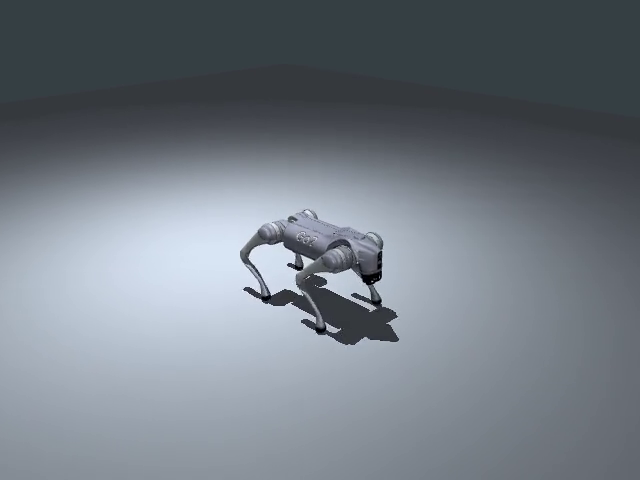
A standalone, simulation-only Go2 body package. It reuses the pinned Unitree
MJCF and a pinned rl_sar Go2 walking policy, then supplies a Native runtime,
ROS 2 feedback bridge and four Robonix device primitives. No physical robot,
Unitree network interface, sport daemon, Docker image or closed-source gait is
needed. This is separate from the validated physical Go2 navigation/RobotTrack
deployment and does not replace it.
Integration and current acceptance
Robonix caller → Atlas discovery → chassis/move gRPC ─────┐
ROS /go2_sim/cmd_vel → Bridge ────────────────────────────┤
Local web velocity controls ─────────────────────────────┤
                                                       ▼
                           localhost HTTP /command → one-writer 0.4 s lease
                                                       ▼
                       body velocity → yaw feedback → pinned RL policy (50 Hz)
                                                       ▼
                       12 named joint targets → bounded PD torque (200 Hz)
                                                       ▼
                             official MJCF + MuJoCo mj_step
                                                       ▼
              odometry / joints / IMU / ray scan / rendered RGB-D / simulation time
                                                       ▼
                         Bridge → ROS 2 / TF → Robonix sensor capabilities
The Native process, not the browser, owns physics. /web is a live RGB camera
preview and command panel, not a MuJoCo WASM implementation. --viewer
opens the full Native 3D scene. Reset is the only direct root-pose assignment;
walking is produced by motor torques and contacts, not pose animation.
On 2026-09-11, with a repeat on 2026-09-12, actual local acceptance covered:
- Standing, forward/backward motion, left lateral motion and both yaw directions. A 0.4 m/s forward command over 5 simulated seconds produced about 1.92 m.
- ROS RGB-D, scan, IMU, joint states, odometry, TF and advancing
/clock; ROS command movement, command-expiry stop, Trigger stop and reset. rbnx boot: Atlas, Soma, Executor and four ACTIVE device primitives; 13 primitive capabilities, without namespace mismatches.- Atlas-discovered gRPC movement: timed velocity, 0.5 m relative motion (measured about 0.47 m at return), 45° rotation (about 42.8° at return), concurrent-call rejection, lifecycle cancellation and invalid-input rejection.
Measured reports: acceptance. The 18-second Native recording shows real simulated walking and turning. These results do not claim terrain robustness, calibrated EDU payload physics, proprietary Unitree 2010 gait equivalence, physical robot performance, autonomous SLAM/Nav2, or language-driven room exploration. Downstream services can consume the interfaces below, but those complete tasks need their own tests.
Requirements and installation
Validated host profile: Ubuntu 22.04 x86_64, Python 3.10, ROS 2 Humble,
MuJoCo 3.3.6, NumPy 1.26.4, CPU PyTorch 2.8.0; EGL for rendered camera frames.
Physics and policy run on CPU. A working OpenGL/EGL context is required for RGB-D;
X11/Wayland is additionally needed for --viewer. Headless does not mean
camera rendering needs no graphics context.
Install ROS 2 Humble, CycloneDDS RMW, standard messages, tf2_ros, colcon and
Robonix using their own installation instructions. Robonix must provide rbnx,
robonix-atlas, robonix-soma, robonix-executor, codegen and a Python
environment containing robonix_api, grpcio and grpcio-tools. Keep gRPC
runtime/codegen versions compatible. No system/ROS dependency installation is
performed implicitly by this repository's build or startup scripts.
git clone https://github.com/Origamii520/robot-unitree-go2-mujoco.git
cd robot-unitree-go2-mujoco
python3 -m venv --system-site-packages .venv
.venv/bin/python -m pip install -r requirements-sim.txt
.venv/bin/python -m pip install torch==2.8.0 --index-url https://download.pytorch.org/whl/cpu
export GO2_SIM_PYTHON="$PWD/.venv/bin/python"
# Optional: a separate existing Robonix Python environment, with grpc and rclpy:
# export GO2_PROVIDER_PYTHON=/absolute/path/to/robonix-env/bin/python
export PYTHONPATH="$PWD${PYTHONPATH:+:$PYTHONPATH}"
bash build.sh
build.sh verifies/downloads 22 immutable model, configuration and license
files, exports a kinematic/inertial URDF for Soma, and runs Robonix codegen/build.
Assets stay in .runtime/assets/. Model and policy pins/checksums are in
assets.lock.json; a modified cached asset causes a digest error instead of being
overwritten. For offline model reuse:
.venv/bin/python scripts/prepare_assets.py --model-source /path/to/unitree_mujoco
Robonix generates a canonical ROS IDL overlay once in the chassis package; the sensor primitives share it. Other generated Python/protobuf artifacts remain per-package. Do not point this overlay at the physical robot deployment.
Start, inspect, stop
Terminal 1 (Native simulation plus ROS Bridge):
bash start.sh                         # headless Native + RGB-D + web preview
# bash start.sh --viewer              # Native interactive 3D viewer
# bash start.sh --duration 75          # bounded simulator lifetime in wall seconds
Open http://127.0.0.1:18765/web. Hold a movement button to refresh its command; releasing it requests zero velocity. Stop/reset affect simulation only. A web owner, ROS stream, and Primitive RPC never add their velocities together. Only one source can refresh a live lease; it expires after 0.4 s without updates.
Terminal 2 (Robonix):
export ROBONIX_ATLAS=127.0.0.1:54151
rbnx boot -f robonix_manifest.yaml --no-update-check
Terminal 3 (inspection):
rbnx caps --server 127.0.0.1:54151 -v
rbnx shutdown -f robonix_manifest.yaml stops this Robonix stack. Ctrl-C in
Terminal 1 stops this simulator and Bridge and releases the renderer. Shutdown
uses this launcher's own child PIDs, never broad pkill. Running without camera
via --no-camera is useful for physics debugging, but the full camera-enabled
Robonix manifest will correctly fail camera readiness in that mode.
Alternatively, after rbnx shutdown, run bash sim/stop.sh from another terminal
to ask the verified local Native endpoint to exit and release its resources.
Private ports: Native HTTP 18765, Atlas 54151, Executor 54161, Soma
54191; provider ports are allocated by Robonix. ROS uses localhost-only
domain 141, CycloneDDS, with task-process DDS configuration overrides cleared.
This is process isolation, not a change to host network configuration. Avoid
using domain 141 for another simulation at the same time. Do not remap these
interfaces to /api/sport/request, /lowcmd, or a physical robot's command topic.
Interface reference
All distances are meters, linear velocities m/s and angular velocities rad/s. Go2 body axes: +X forward, +Y left, +Z up; positive yaw turns left.
| Robonix capability | Native/ROS endpoint | Content |
|---|---|---|
chassis/move |
discovered gRPC | chassis/ExecuteMoveCommand |
chassis/twist_in |
/go2_sim/cmd_vel |
geometry_msgs/Twist |
chassis/odom |
/go2_sim/odom |
nav_msgs/Odometry, body-frame twist |
lidar/lidar |
/go2_sim/scan |
180 actual geometric rays, 20 Hz target |
camera/rgb |
/go2_sim/camera/color/image_raw |
320×240, rgb8, 5 Hz target |
camera/depth |
/go2_sim/camera/depth/image_raw |
same optical geometry, 32FC1 meters |
camera/intrinsics |
/go2_sim/camera/camera_info |
CameraInfo, reliable/transient-local |
camera/extrinsics |
/go2_sim/camera/extrinsics |
TransformStamped, reliable/transient-local |
imu/imu |
/go2_sim/imu |
simulated native gyro/accelerometer, 20 Hz target |
Capability prefixes above abbreviate robonix/primitive/. Every device also
exposes the standard */driver lifecycle capability. Other ROS endpoints:
/clock, /tf, /tf_static, /go2_sim/joint_states, /go2_sim/status,
and Trigger services /go2_sim/stop, /go2_sim/reset.
chassis/move modes follow the standard priority: nonzero forward_m, then
nonzero rotate_deg, otherwise velocity fields plus duration_sec (default 1 s).
Relative movement uses measured pose, not speed-times-duration estimates.
Supported axes are linear_x, linear_y, angular_z. Native limits are
±0.5 m/s forward/backward, ±0.3 m/s lateral, ±0.6 rad/s yaw. Bursts are bounded
to 30 s; larger plans should compose moves. Relative requests support up to 5 m
or 360° with a 30 s timeout. A timeout is reported, never claimed as completion.
Raw HTTP examples for a local simulator only:
curl -s http://127.0.0.1:18765/state
curl -s -H 'Content-Type: application/json' -d '{"owner":"example","velocity":[0.2,0,0]}' http://127.0.0.1:18765/command
curl -s -H 'Content-Type: application/json' -d '{"stop":true}' http://127.0.0.1:18765/command
A single HTTP command lasts at most 0.4 s. Repeat at 10 Hz for sustained motion, or use the timed Robonix interface. This API is loopback-only and is not designed as an authenticated remote-control service.
Reproduce acceptance
bash scripts/validate.sh              # assets, 15 unit tests, six dynamic cases
# With start.sh running, from this repository:
source /opt/ros/humble/setup.bash
export ROS_DOMAIN_ID=141 ROS_LOCALHOST_ONLY=1 RMW_IMPLEMENTATION=rmw_cyclonedds_cpp
export PYTHONPATH="$PWD${PYTHONPATH:+:$PYTHONPATH}"
"$GO2_SIM_PYTHON" scripts/test_ros.py
# With rbnx boot also running; use the Robonix Python environment:
export ROBONIX_ATLAS=127.0.0.1:54151
export PYTHONPATH="$PWD:$(rbnx path robonix-api):$PWD/primitives/go2_sim_chassis/rbnx-build/codegen/proto_gen:$PYTHONPATH"
"${GO2_PROVIDER_PYTHON:-python3}" scripts/test_robonix.py
# Optional actual dynamics recording (ffmpeg required):
MUJOCO_GL=egl "$GO2_SIM_PYTHON" scripts/record_demo.py
Tests actively move only the isolated simulator, so do not run them while
manually driving it. JSON reports are generated under .runtime/. The provided
ci/validate.yaml workflow template runs offline model/command/physics tests;
move it to .github/workflows/validate.yaml when workflow-write permission is
available. The publishing credential does not have that scope, so GitHub Actions
is not claimed as executed. The local ROS/Robonix/EGL acceptance is
recorded separately rather than misrepresented as a cloud end-to-end CI run.
Sources and integration boundaries
- Robonix MuJoCo onboarding guide.
- Unitree Go2 model, BSD-3-Clause.
- rl_sar Go2 policy, Apache-2.0.
- Earlier physical-Go2 resource handoff PR #8 is merged; this independent runtime extends that resource work.
The model is the upstream generic Go2, not a calibrated model of every EDU accessory. RGB-D and planar LiDAR are ideal virtual sensors, not exact D435i or MID-360 replicas. IMU/TF/mounts and the Soma URDF agree with this simulation. The URDF intentionally exports kinematics/inertia without another visual/contact model; the MJCF is authoritative. Its planning footprint is conservative.
The added yaw feedback corrects measured idle drift of this model-policy pairing:
policy_yaw = clip(requested_yaw + 2 × wrap(target_heading − measured_heading), −1, 1).
It does not change policy weights, mesh files, joint ordering or source MJCF.
See NOTICE and LICENSE for attribution.